
Responsible Gambling and Casino Bonuses
 Available in GB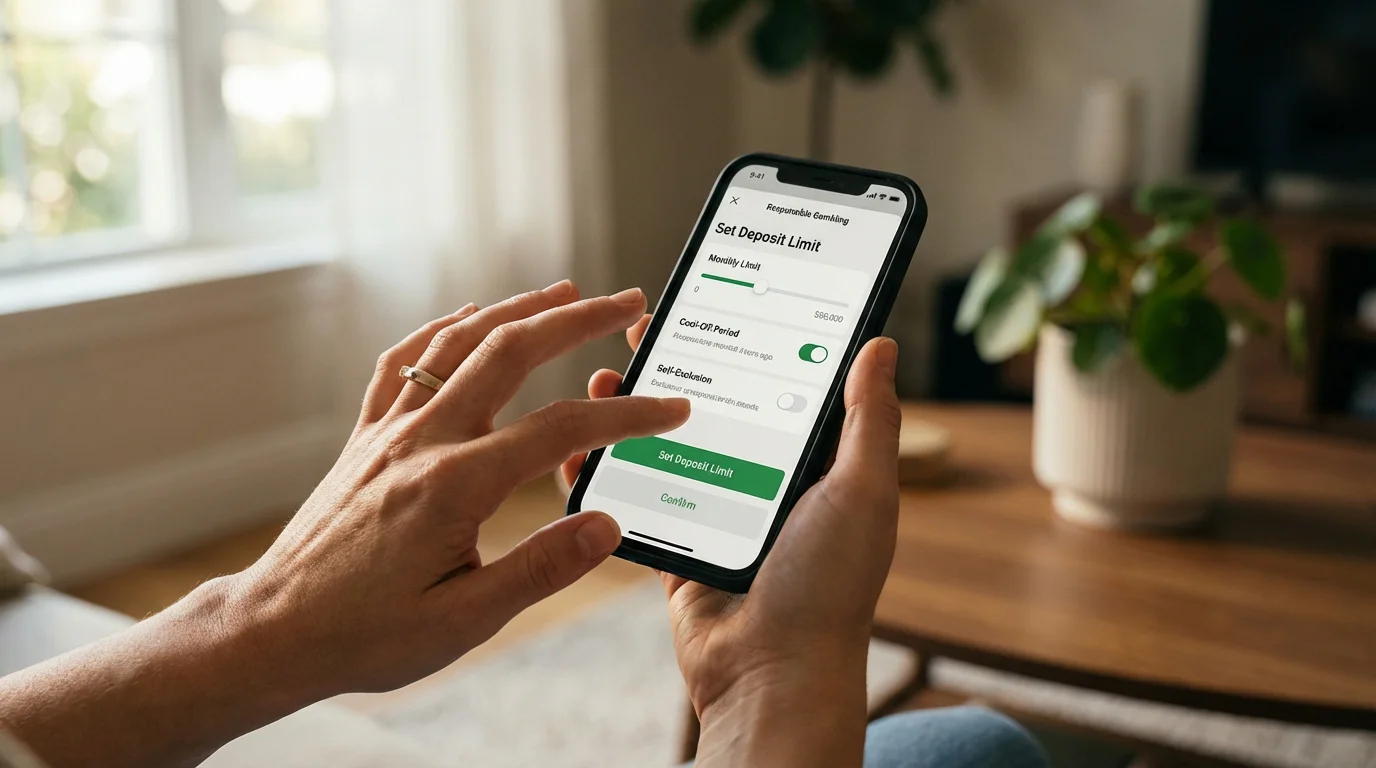
A Free Bonus Can Still Cost You
A free bonus can still cost you if it changes how you gamble. This is the sentence that the entire bonus industry would prefer you not to think about. No deposit bonuses are marketed as risk-free — and in a strict financial sense, they are. You are not depositing money. You are not staking your own funds. If the bonus balance reaches zero, you have lost nothing that was ever in your bank account. That framing is accurate. It is also incomplete.
The risk that no deposit bonuses carry is not financial in the way a deposit is financial. It is behavioural. A bonus gives you access to real casino games with real mechanics — the same spinning reels, the same near-miss animations, the same variable reward schedules that are designed to sustain engagement. Playing with bonus funds teaches your brain the rhythms of gambling without the immediate financial feedback that would otherwise moderate your behaviour. You learn what a win feels like, what a loss feels like, and what chasing a loss feels like — all in an environment where the apparent cost is zero.
For the majority of players, this exposure is benign. They claim a bonus, play through it, perhaps withdraw a small amount or perhaps lose the bonus balance, and move on. The experience is a low-stakes trial of a casino product, exactly as the operator intends. For a smaller but significant minority, the experience plants a seed. The dopamine response to a bonus win is identical to the dopamine response to a real-money win. The near-miss frustration feels the same. The impulse to deposit real money and continue playing after the bonus is gone is a direct consequence of the engagement patterns the bonus session established.
This page is not an argument against no deposit bonuses. It is an argument for claiming them with your eyes open — understanding how bonus play can affect behaviour, knowing the tools available to control that behaviour, and recognising the signs that bonus claiming has shifted from recreational curiosity to something that needs attention.
How Bonuses Affect Gambling Behaviour
The behavioural psychology of casino bonuses operates through several well-documented mechanisms, none of which require the player to spend a single pound of their own money to activate.
The first is habituation. Playing casino games — even with free money — establishes a routine. You learn how to navigate a casino lobby, how to adjust bet sizes, how to read a wagering tracker. These are skills, and developing them creates familiarity. Familiarity reduces the perceived barrier to future engagement. A player who has already completed registration, played through a bonus, and navigated the withdrawal process has eliminated all of the friction points that would otherwise slow a first deposit. The next time the impulse to gamble arises, the path from impulse to action is shorter.
The second mechanism is the near-miss effect. Slot machines are specifically designed so that losing spins frequently display outcomes that are visually close to winning combinations. Two matching symbols followed by a near-match on the third reel triggers a psychological response similar to — though slightly weaker than — an actual win. During bonus play, you experience dozens or hundreds of these near-misses. Each one subtly reinforces the feeling that a win is close, that the next spin could be the one, and that stopping now means missing the payoff. This effect operates identically whether you are playing with bonus funds or real money. The brain does not distinguish between the two sources.
The third is the transition point — the moment the bonus is exhausted and the player faces a choice: stop, or deposit. This is the highest-risk moment in the bonus lifecycle. The player has been engaged in active play, has experienced wins and losses, and is now presented with a frictionless deposit option. The casino’s interface is designed to make this transition seamless: a pop-up offering a deposit match bonus, a pre-populated payment form, a single click between “I was playing for free” and “I am now gambling with my own money.” The speed of that transition is intentional. The less time a player has to deliberate, the more likely the deposit occurs.
The fourth mechanism is loss chasing through bonus hopping. A player who loses a bonus balance at one casino may immediately seek another no deposit offer at a different casino — not because they want to evaluate a new operator, but because they want to continue the emotional experience of play. This pattern can escalate: claiming five, ten, or twenty bonuses across different casinos in a single session, each one feeding the same cycle of anticipation and disappointment. The financial cost may be zero, but the time investment, the emotional toll, and the progressive normalisation of constant gambling engagement are real costs that do not appear on any balance sheet.
Tools for Staying in Control
The UK regulatory framework provides a comprehensive set of tools for players who want to manage their gambling behaviour. These tools are not optional features — UKGC-licensed operators are legally required to offer them, and the 2026 reforms have strengthened the requirements around their visibility and accessibility.
Deposit limits allow you to set a maximum amount you can deposit within a defined period — daily, weekly, or monthly. While these do not directly apply to no deposit bonuses (since no deposit is made), they serve as a critical backstop for the transition from bonus play to real-money play. Setting a deposit limit before you claim your first bonus means that even if the impulse to deposit arises after the bonus is exhausted, the system will enforce a ceiling. You can lower a deposit limit at any time, with immediate effect. Raising a limit requires a cooling-off period of at least 24 hours — a deliberate design that prevents impulsive increases.
Session time limits allow you to set a maximum duration for each gambling session. When the limit is reached, the system interrupts play with a notification. Some operators enforce the limit by logging you out automatically; others display a pop-up that requires active acknowledgement before play can continue. For bonus play specifically, a session limit prevents the kind of extended bonus-hopping that can escalate engagement without financial markers. If you set a 30-minute session limit, you are forced to take a break and re-evaluate regardless of whether you are playing with bonus funds or real money.
Reality checks are periodic notifications — typically every 30, 60, or 90 minutes — that display your session duration, net wins or losses, and wagering totals. These serve as circuit breakers for the flow state that casino games are designed to induce. A reality check during bonus play might reveal that you have been playing for two hours, have cleared £30 in wagering, and have a bonus balance of £1.50. That information, delivered at the right moment, can be the difference between closing the tab and seeking another bonus at a different casino.
Self-exclusion is the most comprehensive tool, and it operates at two levels. Individual casino self-exclusion locks you out of a single operator’s site for a minimum period (typically six months, one year, or five years). GAMSTOP is the national self-exclusion scheme: registering with GAMSTOP excludes you from all UKGC-licensed online gambling sites simultaneously, for a period of six months, one year, or five years. GAMSTOP exclusion applies to bonus claiming as well as real-money play — you cannot register, deposit, or claim any offer at any participating site during the exclusion period.
One practical note: GAMSTOP covers UKGC-licensed operators only. If you have been claiming bonuses at non-UKGC-licensed sites (which is itself a risk, as discussed elsewhere in this cluster), GAMSTOP will not block access to those sites. This is one of many reasons to restrict bonus claiming to regulated operators.
Recognising When Bonus Claiming Has Shifted
The line between recreational bonus claiming and problematic behaviour is not always obvious. There is no single moment where a player crosses from one to the other. The shift is gradual, and the markers are behavioural rather than financial — which makes them harder to recognise, particularly when the financial cost remains zero.
Time is the first signal. If you are spending more time searching for, claiming, and playing through no deposit bonuses than you intended — or more time than you spend on other leisure activities you previously enjoyed — the pattern has shifted. Bonus claiming that started as a ten-minute curiosity and has become a two-hour daily habit is escalating, regardless of whether any money has changed hands.
Emotional response is the second signal. If you feel frustrated, anxious, or agitated when a bonus balance reaches zero — if the end of a free play session produces genuine distress rather than mild disappointment — the emotional investment has outpaced the financial reality. You are experiencing real losses from free money, and that mismatch between the objective and subjective experience is a warning sign.
Deposit impulse is the third signal. If every bonus session ends with you considering a deposit — even if you resist most of the time — the bonus is functioning as a gateway rather than a standalone experience. The question is not whether you deposited, but whether the impulse to deposit is becoming more frequent, more persistent, and harder to dismiss. A progression from “I wonder what depositing would be like” to “I need to deposit to win back what I just lost on a free bonus” is a clear escalation.
If any of these signals are present, the responsible action is to use the tools described above. Set a session limit. Activate reality checks. Take a break. If the impulse to continue feels stronger than the decision to stop, consider GAMSTOP or speak to a support service. GamCare (0808 8020 133) and the National Gambling Helpline offer free, confidential advice. These services exist because the path from free play to problematic gambling is well-documented, predictable, and navigable — if you recognise it early enough.
Free Doesn’t Mean Harmless
No deposit bonuses are a legitimate and regulated feature of the UK online casino market. They provide genuine value: the opportunity to evaluate a casino at zero financial cost. The 2026 reforms have made the terms more transparent, the wagering more reasonable, and the overall experience more honest than at any previous point in the market’s history.
None of that changes the fundamental nature of what a bonus gives you: access to real gambling products with real psychological effects. The money may be free. The experience is not. It carries the same dopamine responses, the same near-miss mechanics, and the same engagement patterns as real-money play. For most people, that is fine. For some, it is the beginning of something that requires attention.
Claim bonuses if you want to. Enjoy them for what they are. But set your limits before you start, not after you feel you need them. The tools are there. Use them early, and they protect you quietly. Wait too long, and you are asking them to pull you out of something that could have been prevented. The best time to think about responsible gambling is before you enter a single bonus code — not after you have entered fifty.
Gamble responsibly — start at nodepositbonuscodesuk. Also read our UKGC casino bonus rules 2026.