
Online Casino Game Shows in the UK: How They Work
 Available in GB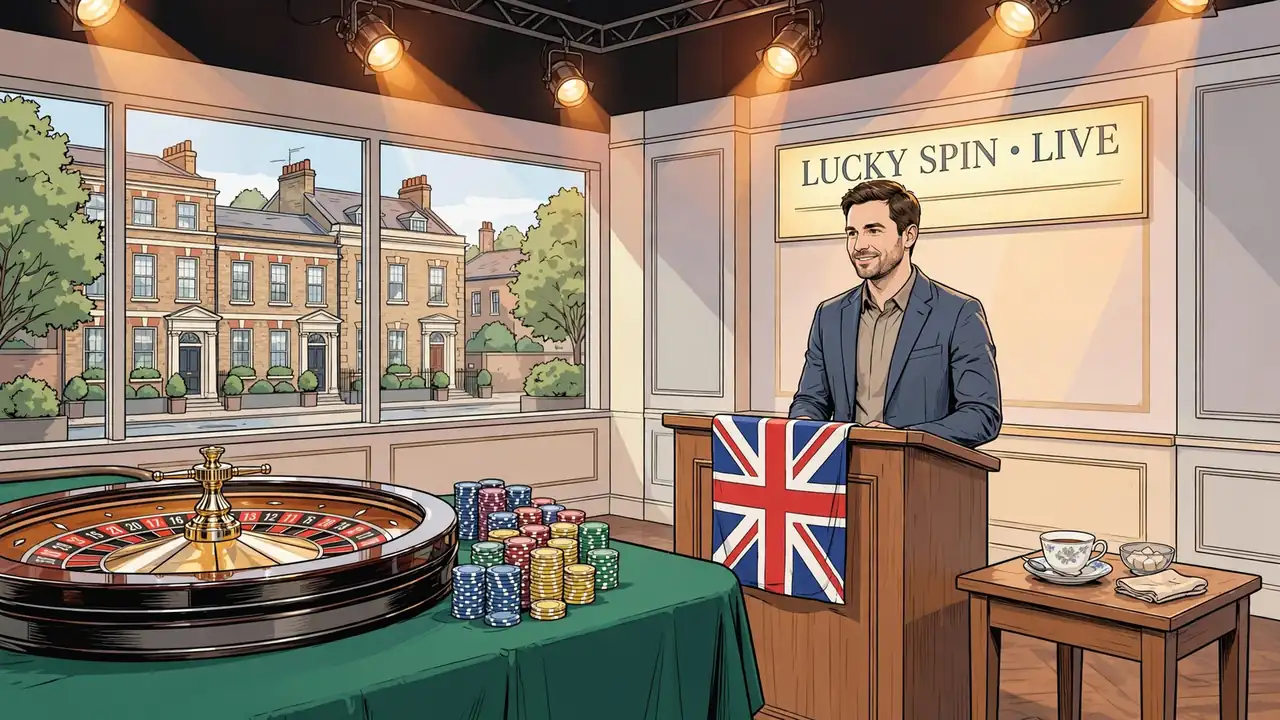
Hosted rounds pair studio presentation with a wheel, cards, numbered positions or another game mechanism.
How Online Casino Game Shows Work
Online casino game shows combine elements of a casino game with the presentation of a televised entertainment programme. Instead of displaying only reels, cards, or a digital betting interface, the platform presents a hosted event with a studio setting, a presenter, and a sequence of rounds. The result is a format that is recognisable as gambling but is organised around visual presentation and scheduled game phases.
The central idea is that the game is conducted as an event rather than as a single isolated action. A participant selects an available wager, the round opens, and the host or studio presentation guides the event towards its outcome. Depending on the particular title, the decisive action may involve a wheel, cards, numbered positions, a board, or another game mechanism. The visual layer does not alter the underlying monetary risk: the outcome remains a gambling result, and any return depends on the rules attached to the selected wager.
The studio format
A conventional online casino game normally places the game mechanism at the centre of the screen. A slot may show reels and symbols; a digital table game may show cards, a layout, or a roulette wheel. The action is generally compact and can be repeated whenever the interface permits. There may be animation and sound, but these are supporting elements around a relatively direct transaction: a stake is made and the software produces an outcome.
A live game show casino format gives the presentation a more prominent role. The screen may contain a presenter, a set designed to resemble a broadcast studio, a game board, and information about the current round. The host explains or announces stages of play, while the interface records available selections and displays the result. The studio is therefore not merely decorative. It structures the pace of the game and provides a visible sequence through which the round develops.
The word “live” generally refers to the live-broadcast or live-presented character of the event. It should not be taken to mean that a participant can influence the mathematical outcome, negotiate the rules, or request a different result. A presenter can explain the round and operate the visible equipment, but the wagers remain subject to the published rules and the result-determination process used by the game.
Online Casinos With No Limits in the UK: What It Means
The broadcast may also include interaction between rounds. A presentation can show a countdown, explain the next betting stage, display recent results, or provide information about the available options. Those features make the product feel closer to a television game show than to a conventional casino screen. They do not, by themselves, establish that a game has better odds, a lower risk, or a more favourable return.
How a round is organised
Although designs differ, an online casino game show commonly divides play into recognisable stages.
First, the interface presents the current round and the possible wager selections. The available options are normally shown with their associated rules or potential returns. A participant chooses a stake and a selection through the casino interface. The platform then closes or suspends betting before the decisive action takes place.
Next, the presenter or game system conducts the visible part of the round. This may involve a wheel being turned, cards being revealed, a position being selected, or another event taking place on the studio set. The precise procedure belongs to the individual game. It should not be assumed that every title uses the same equipment, timing, or settlement method.
Finally, the result is matched against the wagers placed in that round. Winning selections are settled according to the game’s rules, while losing selections do not produce a return. The balance shown in the account is adjusted by the operator’s system. The presenter’s announcement and the on-screen result are part of the presentation; the account settlement is the relevant financial record.
This sequence separates game-show play from a basic instant game. In an instant game, the interface can often move from selection to outcome with very little visible staging. In a show-based game, the time between those points is part of the product. The pause may allow the studio presentation to explain the round, but it also means that the pace is not determined solely by how quickly a participant clicks.
What “live” changes, and what it does not
The live presentation changes the experience of using the game. It can make the round easier to follow because the stages are announced and displayed. It can also make the product more social in appearance: the studio, host, and other visible elements create a sense of a shared broadcast rather than a solitary software session.
DO
- Check the operator’s current British lobby for availability
- Verify the game is playable for real money
- Confirm the operator holds a UKGC licence
DON’T
- Assume a promotional banner means the title is currently playable
- Rely on a provider’s website to confirm availability at a specific casino
- Assume a game is available just because it is advertised internationally
That atmosphere should be distinguished from the legal and financial structure of the activity. A hosted game is still remote gambling when it is supplied through an online casino. The presenter is not a financial adviser, and the entertainment value of the broadcast is not evidence about the likelihood of a particular result. A lively set, dramatic music, or a sequence of celebratory animations does not change the wager or the rules.
The presence of a person on screen also does not necessarily mean that every aspect of the game is decided manually. A studio may present the visible action while the operator’s technical systems record bets and settle accounts. The precise relationship between the presenter, the equipment, the game software, and the settlement system is determined by the product’s rules and technical design. General assumptions about how one live show works should not be transferred automatically to another.
For the same reason, a game should not be assessed only by whether it looks authentic or resembles a television programme. Important details include the permitted wager choices, the way returns are calculated, the point at which betting closes, and the conditions under which a result is settled. These are functional features, not production details.
Amatic Casinos UK: How Games Reach Casino Lobbies
Online access and the casino interface
An online casino game show is accessed through the operator’s website or application rather than through a television channel. The casino account remains the point at which funds are deposited, wagers are recorded, and winnings are credited. The show is presented within that account environment, alongside other casino products.
The screen usually has two connected parts. One area carries the video or studio presentation. Another contains the betting controls, the current round information, and the account balance. On a smaller screen, these elements may be rearranged or displayed in stages. The underlying game need not change merely because the layout changes, but the amount of information visible at once can differ between devices.
A stable connection is important to the viewing experience because the product depends on a continuing stream of video and game information. However, technical continuity is not the same as control over the outcome. If a connection fails, the operator’s rules determine how the interrupted round is treated. The relevant provisions may address whether a wager was accepted, whether the result had already been determined, and how the account is updated. Those provisions should be read as part of the individual game’s terms rather than inferred from the presence of a live broadcast.
A streamed picture can reach a device after the studio action has occurred. This delay does not necessarily indicate that the result is still open for selection.
The same distinction applies to delays. A streamed picture can reach a device after the studio action has occurred. That delay does not necessarily indicate that the result is still open for selection. The betting interface controls whether a wager can be accepted. Once the betting phase has closed, watching the continuing broadcast does not reopen it.
Game-show presentation compared with conventional casino games
The difference between these products is primarily one of format and pacing, although the underlying game rules remain decisive.
| Feature | Conventional online casino game | Online casino game show |
|---|---|---|
| Main presentation | Reels, cards, layouts, or other software graphics | Studio presentation combined with a casino interface |
| Pace | Often driven by the participant’s next action | Organised into host-led or system-led rounds |
| Visual focus | The game mechanism itself | Presenter, set, game equipment, and round information |
| Interaction | Usually limited to selecting wagers and game controls | Wagers are selected within a staged broadcast sequence |
| Financial result | Settled under the individual game rules | Also settled under the individual game rules |
This comparison does not make one format inherently preferable. A participant interested in rapid, self-paced play may regard the staged pauses as a disadvantage. Someone who values explanation and presentation may regard the same pauses as part of the appeal. Neither preference says anything about the expected financial return.
A show format can also make the rules appear simpler than they are. The visible action may be easy to understand while the wager types contain separate conditions. For example, several selections may be presented on one screen but may not have the same probability, return, or settlement treatment. The fact that all options appear in a single graphic does not mean that they carry equivalent risk.
The role of the presenter
The presenter gives the product its most obvious game-show characteristic. Their role may include welcoming participants, describing the available selections, announcing the opening and closing of betting, operating studio equipment, and confirming the visible result. The host can also maintain continuity between rounds, which makes the broadcast easier to follow than a sequence of disconnected software animations.
The presenter’s role should not be confused with that of the operator. The operator supplies the gambling service, manages the account, applies the game rules, and handles account-related matters. A host on the broadcast does not decide whether a deposit is accepted, alter a wager after it has been placed, or provide the operator’s customer-support function.
Amatic Online Casinos UK: Games, Access and Operators
Nor should presenter behaviour be treated as a source of predictive information. A comment about a previous result, an emphasis placed on one part of the set, or a dramatic pause has entertainment value but does not create a reliable method of forecasting the next outcome. Past results displayed during a broadcast are historical information. They do not, by themselves, change the rules for the next round.
Regulation of the activity
The regulatory position concerns the gambling service, not simply the appearance of the broadcast. In Great Britain, remote gambling supplied to consumers falls within the remit of the UK Gambling Commission even when technical equipment supporting the service is located elsewhere. The Commission is the regulator responsible for commercial gambling in Great Britain, including online casino activity.
Businesses operating gambling services require the appropriate operating authorisation, while individuals performing regulated roles may require a personal licence. These are different forms of permission. A presenter appearing in a broadcast is not, merely by appearing on screen, the holder of the casino’s operating authorisation. The relevant regulatory responsibility rests with the licensed gambling business supplying the service.
Attention A presenter is not a financial adviser, and the entertainment value of a broadcast is not evidence about the likelihood of a particular result.
This distinction matters because an online game show can look like entertainment media while functioning as a gambling product. Its classification is not determined by the studio set, the tone of the presenter, or the resemblance to a television programme. The decisive issue is whether the service gives participants an opportunity to place casino wagers remotely and receive results under gambling rules.
A lawful British offering therefore sits within the operator’s regulated remote-gambling service. The broadcast presentation does not create a separate legal category outside the casino. The game remains subject to the operator’s obligations, the published terms, and the regulatory framework applicable to the service.
Reading the product accurately
The most useful way to understand an online casino game show is to separate four layers that are often presented together:
- The broadcast layer — the studio, presenter, sound, graphics, and visible sequence of events.
- The game layer — the rules governing selections, round stages, results, and returns.
- The account layer — deposits, wagers, balance movements, and settlement records.
- The regulatory layer — the licence and compliance duties applying to the operator supplying the remote gambling service.
Confusion arises when these layers are treated as interchangeable. A polished broadcast does not prove favourable game rules. A recognisable presenter does not replace the operator’s obligations. A visible result does not explain every wager type. An attractive interface does not determine whether the service is legally authorised for the market in which it is offered.
Live casino game shows are therefore best understood as hosted, broadcast-style casino products. Their distinctive feature is the combination of a visible studio event with remote wagering and account settlement. The entertainment structure affects how the round is experienced; the individual rules determine how it operates; and the licensed operator remains responsible for supplying the gambling service within Great Britain’s regulatory framework.
Finding Live Game Shows at UK Online Casinos
Access to a live game show depends on more than the presence of a casino brand on the British market. The operator must make the relevant live content available in its lobby, the title must be supplied through an approved technical arrangement, and the game must be enabled for the account and jurisdiction concerned. A casino may therefore offer remote gambling legally without carrying every live game-show title.
This distinction matters when comparing online casinos with live game shows in the UK. A casino’s general reputation, its selection of ordinary slots, or the fact that it offers live-dealer tables does not establish that it also provides game-show content. Availability is a product-level question. It has to be checked in the current lobby or in the operator’s published catalogue rather than inferred from the casino’s wider range.
A casino licence does not identify its full catalogue
The UK Gambling Commission regulates commercial gambling supplied to consumers in Great Britain. Remote gambling operators serving this market must hold the relevant UKGC licence, even where their business or technical infrastructure is located elsewhere. The licence concerns the operator’s authority to provide gambling services; it is not a public guarantee that every category of game is present on the site.
Amatic Online Casinos in the UK: How Games Are Offered
The same principle applies to software suppliers. A provider may hold a UK Gambling Software (Remote) licence that permits distribution of games to licensed operators without accepting deposits from players. In that arrangement, the operator remains responsible for the player account, deposits, withdrawals, bonus conditions and customer support. The supplier’s authorisation does not turn its catalogue into a standalone casino and does not show which individual operators currently carry any particular title.
Accordingly, a reference to a software company in a casino’s technical or promotional material should not be treated as proof that live game shows are available there. It may indicate a commercial relationship, but the relevant question is whether the operator presently displays and enables the particular live section for British customers.
What to check in a casino lobby
The most direct evidence is the operator’s current game lobby after the account has been set to the appropriate British market. Live content may be separated from slots, table games and other casino products under labels such as live casino, game shows or live games. The exact menu structure varies, so the absence of one particular label does not by itself settle the question. A title search, the live section and the operator’s help pages may need to be considered together.
New Online Casino Sites in the UK: Amatic Evidence
A catalogue page should identify the game as live content rather than merely showing a promotional image. A real live game-show offering normally has information about the game interface, opening times or streaming format, although the amount of information differs between operators. Promotional banners can remain visible after a title has been withdrawn, restricted or replaced. For that reason, the playable lobby entry carries more weight than a banner or an old review.
Geographical and account restrictions also affect what is displayed. A site may advertise a supplier or a category internationally while presenting a different selection to customers in Great Britain. A mobile lobby can likewise differ from the desktop presentation because the operator uses separate menus or technical feeds. Availability should therefore be assessed in the actual account environment in which the game would be played, not solely on a general landing page.
The role of providers and aggregators
Live game shows reach casino lobbies through commercial distribution arrangements. An operator can integrate directly with a provider or obtain access through an aggregator. In both cases, the route by which the game arrives is separate from the question of whether the operator has chosen to publish it to its customers.
Wazdan Online Casinos in the UK: What Can Be Verified
This explains why two licensed casinos can have different live selections. They may use different suppliers, different aggregation feeds, different commercial terms or different editorial decisions. Even where two brands belong to the same wider business, their lobbies need not be identical. A shared payment system or common ownership is not evidence of a shared live-game catalogue.
A provider’s own website can be useful for identifying the nature of its products, but it is not a substitute for checking the operator’s current British lobby. A provider does not normally determine the complete public selection at every casino. The operator decides which authorised games are made visible, which markets receive them and whether particular titles remain active.
The reverse inference is also unsafe. A casino may list live casino products while omitting a supplier’s name from the public lobby. The absence of a provider logo does not prove that no live game show is available. The reliable point is the operator’s current, playable catalogue and its terms for the British service.
How to compare casinos without inventing a ranking
The phrase “best” is not a single measurable category in this market. One comparison may emphasise the size of the live section; another may consider the clarity of game information, account controls, payment arrangements or the treatment of promotional funds. Without a defined method and current, operator-specific evidence, a universal ranking of the best live-game-show casinos would give a false impression of precision.
A more defensible comparison separates several questions:
- Is the operator authorised to provide remote gambling to customers in Great Britain?
- Does the current British lobby contain a distinct live game-show category or identifiable live game-show entries?
- Are the titles available for real-money play, demonstration only, or both?
- Are access conditions different between desktop and mobile?
- Does the operator explain any regional, account or session restrictions?
- Are the rules for deposits, withdrawals and promotional funds stated clearly?
- Are safer-gambling controls available before play begins?
The first point concerns legal access; the remaining points concern the actual product and account experience. A casino can satisfy one without satisfying all the others. For example, a licensed operator may offer live-dealer games but no game-show titles, or may list a live category whose contents change over time.
Account and regulatory checks
A UK-facing casino’s regulatory status should be checked against the Gambling Commission’s public register rather than inferred from a logo, affiliate description or search-result wording. The Commission regulates gambling activity in Great Britain and grants permissions to both businesses and relevant individuals. The operator named in the account and terms should correspond to the licensed business providing the service.
This check is particularly important where a group operates several brands. A familiar brand name does not remove the need to identify the legal operator behind the British site. The licence status of one brand cannot automatically be transferred to another, and a software supplier’s UKGC licence is not the same as a consumer casino operating licence.
UK Regulatory Requirements
Online gambling is lawful for adults aged 18 and over when supplied by a properly licensed operator. Age verification must take place before funds can be deposited, and customer identity details must be checked before the first deposit. UKGC-licensed operators must also prompt customers to set a financial limit before that first deposit.
The legal framework also affects the conditions under which live casino products are offered. Online gambling is lawful for adults aged 18 and over when supplied by a properly licensed operator. Age verification must take place before funds can be deposited, and customer identity details must be checked before the first deposit. UKGC-licensed operators must also prompt customers to set a financial limit before that first deposit; a reduction to an existing limit must be applied immediately.
GamStop is mandatory for online operators licensed to serve Great Britain. It is therefore part of the regulatory setting for a UK online casino, not an optional feature that can be assumed for every site using British language or currency. Offshore casinos operate outside the UKGC system and should not be presented as equivalent alternatives. They do not provide the same UK regulatory framework, and their presence of a live-game-show label does not create UKGC oversight.
Promotions should be separated from availability
A bonus advertisement is not proof that a casino has a stable live game-show selection. Promotions can apply only to selected products, exclude live games, or impose conditions that differ from the general casino terms. The relevant promotional wording should identify the eligible games, the treatment of winnings and any wagering requirement before the offer is considered part of the comparison.
For UK customers, wagering requirements attached to bonus funds are capped at ten times the bonus amount under the Gambling Commission’s rules that took effect on 19 December 2025. That cap does not mean every promotion is equally suitable or that every live game contributes in the same way. A casino may apply lower limits, exclude particular games or attach separate terms within the permitted framework.
Betsoft Online Casinos UK: What the Evidence Shows
Promotional material also should not be confused with the cash price of play. A live game-show lobby may display free-play or bonus messaging while the underlying game remains subject to the operator’s normal account and stake rules. No conclusion about value follows from the existence of a promotion alone.
The prohibition on credit-card-funded remote gambling is part of the same consumer-protection context. It covers credit-card-funded e-wallet top-ups as well as direct card payments. A payment method displayed by a casino should therefore be assessed in light of the funding source and the operator’s current controls, not merely by the name of the wallet or payment service.
Availability changes over time
Live content is less static than the existence of a casino licence. Operators can add or remove titles, alter lobby categories, discontinue feeds or restrict a game to particular accounts and markets. A review that accurately described one operator at an earlier date may not establish the present selection. The same caution applies to provider lists, promotional pages and comparison tables reproduced across different sites.
A current check should record the date of the lobby review and the precise operator brand examined. It should also distinguish an advertised title from a playable one. If the live section is visible only after registration, the fact should be treated as an access condition rather than silently generalised to all visitors. If a game appears on desktop but not mobile, the difference is material.
Essential Evidence
The meaningful evidence is the combination of a current British operating licence and a current, accessible catalogue showing the relevant live products.
This approach avoids two opposite errors. It avoids treating every casino as a live game-show casino merely because it offers remote gambling, and it avoids treating a missing promotional banner as proof that no such content exists. The meaningful evidence is the combination of a current British operating licence and a current, accessible catalogue showing the relevant live products under the operator’s own account environment.
Practical comparison criteria
For a structured assessment of online casinos that carry live game shows in the UK, the following order keeps legal status separate from catalogue claims:
- Identify the licensed operator. The business providing the account should be matched with the Gambling Commission’s public register.
- Check the British-facing lobby. The relevant live category or title should be visible in the service intended for Great Britain.
- Confirm the game status. The entry should be playable or clearly described as available, rather than appearing only in an old article or a general provider catalogue.
- Read the product terms. Rules for stakes, eligibility, interruptions, settlements and promotional contribution should be clear enough to distinguish live game shows from other casino products.
- Review account safeguards. Age verification, financial-limit prompts and GamStop access form part of the licensed operating environment.
- Recheck before depositing. Catalogue content and promotional terms can change, so a historical listing should not be treated as a permanent guarantee.
This method describes where live game shows may be found without turning a changing catalogue into an unsupported league table. The central relationship is straightforward: legal access comes from the licensed operator, while the availability of a particular live game show comes from the operator’s current product selection and distribution arrangements. Neither fact can safely be inferred from the other.
Crazy Time and Funky Time: Show-Specific Context
Treating the names as format labels
Crazy Time and Funky Time are names associated with live casino game-show searches rather than generic descriptions of every studio-based casino product. The names therefore need to be kept separate from the wider category. A casino may advertise a live game show without offering either of these particular formats, while a reference to one of the named formats does not establish that every feature associated with the broader category is present.
The names alone also do not establish the operator, supplier, licence status, availability, or current presentation of a game. Those details belong to the casino offering the title to British customers. A game-show name is not a substitute for checking whether the relevant operator is authorised to provide remote gambling in Great Britain.
What can and cannot be inferred
Search interest in Crazy Time commonly reflects an attempt to find a live, televised-style casino experience rather than a conventional reel-based slot. Funky Time is sought in a similar context. That indicates the type of product being investigated, but it does not justify assigning particular rules, bonus stages, betting options, presenters, or prize structures to either title without product-specific evidence.
This distinction matters because live casino game shows can differ substantially in their underlying rules. Some use a studio host and a central visual device; others may combine several game phases or present additional features between standard betting rounds. Those characteristics cannot be transferred from one named title to another merely because both are described as game shows. Nor can a general description of the category confirm the mechanics of either Crazy Time or Funky Time.
A title can appear in an operator’s catalogue, be unavailable in a particular jurisdiction, or be withdrawn while older promotional material remains visible elsewhere.
The same caution applies to availability. A title can appear in an operator’s catalogue, be unavailable in a particular jurisdiction, or be withdrawn while older promotional material remains visible elsewhere. A listing is not proof that a game can be played at the time of checking. Availability should be established through the current lobby of a UKGC-licensed operator, with the operator’s own terms governing account access, deposits, withdrawals, and any promotion attached to the game.
The UK regulatory boundary
Remote gambling offered to consumers in Great Britain must be provided by an operator holding the relevant UKGC licence. The Gambling Commission regulates commercial gambling in Great Britain and issues operating licences to businesses, as well as personal licences for individuals working in relevant gambling roles. Consequently, a named live-show title should be assessed through the operator supplying it, not through the title alone.
A provider’s authorisation to supply software has a different function from an operator’s permission to accept bets. Software licensing does not turn the supplier into a consumer-facing casino and does not itself confirm that a particular game is available to British players. The operator remains the party responsible for the gambling account, deposit handling, payouts, customer support, and applicable account controls.
For a lawful British offering, age verification must take place before funds can be deposited, and the operator must prompt the customer to set a financial limit before the first deposit. GamStop is mandatory for UKGC-licensed online operators. These controls concern the licensed gambling service, not the branding of the individual show.
Live show does not mean unrestricted play
The word “live” describes the presentation or operating model; it does not remove the rules that apply to remote gambling. A studio broadcast, host-led interface, or scheduled game round remains part of a regulated online gambling service when real money is involved. The title’s visual style therefore says nothing by itself about deposit methods, withdrawal arrangements, bonus conditions, or safer-gambling controls.
Amatic Casinos in the UK: Games and Availability
Promotional wording requires particular care. A bonus connected with a named show may have eligibility conditions, expiry provisions, and wagering requirements that differ from the underlying game. For UK players, wagering requirements on bonus funds are capped at ten times the bonus amount under the applicable rules. A promotion should not be treated as cash, and a stated prize should not be treated as withdrawable funds, unless the operator’s current terms support that interpretation.
Checking the two named titles
A sound comparison of Crazy Time and Funky Time would require current, title-specific evidence covering at least the game rules, the operator presenting each title, the permitted jurisdictions, the available stake options, and the relevant terms. Those details should not be reconstructed from the names or from assumptions about live game shows generally.
The practical distinction is therefore narrow but important: Crazy Time and Funky Time should be treated as separate branded formats, not as interchangeable labels and not as evidence that every casino advertising live game shows carries either one. Their presentation may attract the same kind of interest, yet their rules and availability must be established independently. For British players, the decisive regulatory question remains whether the operator providing the particular title holds a current UKGC licence.
What “Live Casino Game Show” Means
A live casino game show is a form of remote gambling presented as an entertainment programme rather than as a conventional digital table or slot game. The central screen normally resembles a studio broadcast: a presenter, a set, branded graphics and a sequence of rounds are combined with a betting interface. The outcome is generated during the broadcast, while the casino account records the relevant stake and return.
Live casino game show
A form of remote gambling presented as an entertainment programme where a studio broadcast, presenter, and set are combined with a betting interface.
The expression contains two separate ideas. Live casino describes the real-time presentation and the use of a streamed studio or presenter-led environment. Game show describes the structure: rounds, announcements, visual effects, audience-style presentation and a format built for viewing as well as betting. The label therefore refers to how the product is delivered and staged, not to one particular game or software supplier.
This distinction matters because the term is broader than the name of any individual format. A branded show may have its own wheel, board, bonus sequence, number selection or other central device. Those features identify that particular title. The words “live casino game show”, by contrast, describe the category into which such titles may fall. They do not establish the rules, payment structure, stake conditions or return settings of a specific product.
How the label differs from other casino products
A conventional online slot is primarily a software interface in which the player starts a game cycle and receives the result through reels, symbols or animations. It does not require a presenter or a continuing studio broadcast. A standard digital table game may reproduce cards, a wheel or another table mechanism on screen, but it can operate without a live programme surrounding it.
A live-dealer table game has a presenter or dealer and a streamed table, but it is not automatically a game show. Its presentation may be formal and functional, with the broadcast serving to show the dealing or wheel process. A game-show product adds a more overt programme structure: the presenter, set and staged sequence are part of the identity of the title rather than merely a way to display a table.
The boundaries are not absolute. Products can borrow elements from more than one category, and casino menus may place them under headings such as live casino, game shows or live games. The category shown in a lobby is therefore a navigation label, not a complete description of the rules. The individual title’s information page remains the relevant place for its betting procedure, eligible outcomes and applicable terms.
Amatic Slots in UK Online Casinos: Games and Rules
What “live” does and does not mean
“Live” generally indicates that the visual presentation is connected to a real-time studio or presenter-led feed. It should not be read as a promise that every part of the experience is physically determined in front of the viewer. The broadcast, the betting interface, the game logic and the settlement of winnings are related components, but the label alone does not explain the technical arrangement behind them.
Nor does the word guarantee continuous availability, a particular presenter or a specific level of interaction. A product can retain the live-show format while using scheduled sessions, recorded presentation elements or automated parts of the programme. Such details depend on the operator’s description and the rules for the title. The general label cannot settle them.
The same caution applies to the word “casino”. In this context, it identifies the gambling setting in which the show is offered. It does not turn the product into a conventional casino table game, and it does not describe the operator’s licensing position by itself. For British customers, real-money remote gambling is lawful only when supplied by an operator holding the relevant UKGC licence. A software provider’s role is separate from the operator’s responsibility for the account, deposits, payouts and customer support.
Barcrest Online Casinos UK: What the Evidence Shows
Interpreting the term in a casino lobby
A search for a live game-show casino can therefore lead to several different types of result: an operator’s live-games area, an individual show, a category page or an explanation of the format. These are not interchangeable. A casino page indicates where the product is offered; a title page explains how one show works; and a general description defines the category without selecting a particular operator or game.
The label also says nothing by itself about value. It does not establish a return rate, volatility, minimum or maximum stake, bonus eligibility, withdrawal condition or complaint route. Those matters belong to the specific title and the licensed operator’s terms. Promotional wording should not be treated as a substitute for those rules.
Finally, “live casino game show” is best understood as an umbrella description: a presenter-led, studio-style gambling product delivered through a remote casino service. The named formats discussed elsewhere are narrower instances with their own identities and mechanics. Keeping that distinction clear prevents a category label from being mistaken for a complete description of any one show.
What bonuses and free spins are available at Amatic casinos in the UK?
32Red, Betfred and Bet365 offer free-spin wins with 0× wagering, so winnings are credited as cash without a playthrough requirement. Bet365’s offer requires a £10 minimum lifetime deposit and distributes up to 500 spins over 10 days.
Can I deposit with cryptocurrency at a site offering Amatic slots?
No UKGC-licensed operator was confirmed as accepting cryptocurrency for Amatic play. Offshore casinos that offer Amatic games operate outside the UK regulatory framework.
Are Amatic slots covered by GamStop self-exclusion?
Yes. GamStop is mandatory for all Great Britain-licensed online operators, and Amatic games are supplied through UKGC-licensed operators.
Can Amatic slots be played on a mobile phone in the UK?
Yes. Amatic games generally run in a mobile browser as HTML5 games, so they do not require a download.
How does the UK’s 10× wagering cap affect Amatic casino bonuses?
Since 19 December 2025, wagering requirements on bonus funds at UK-licensed operators cannot exceed 10× the bonus amount. The cap applies to the operator’s bonus terms, not specifically to Amatic games.